The Painter Who Threw Down His Brush
A Daoist idea for the moments when you’re trying too hard to get it right.
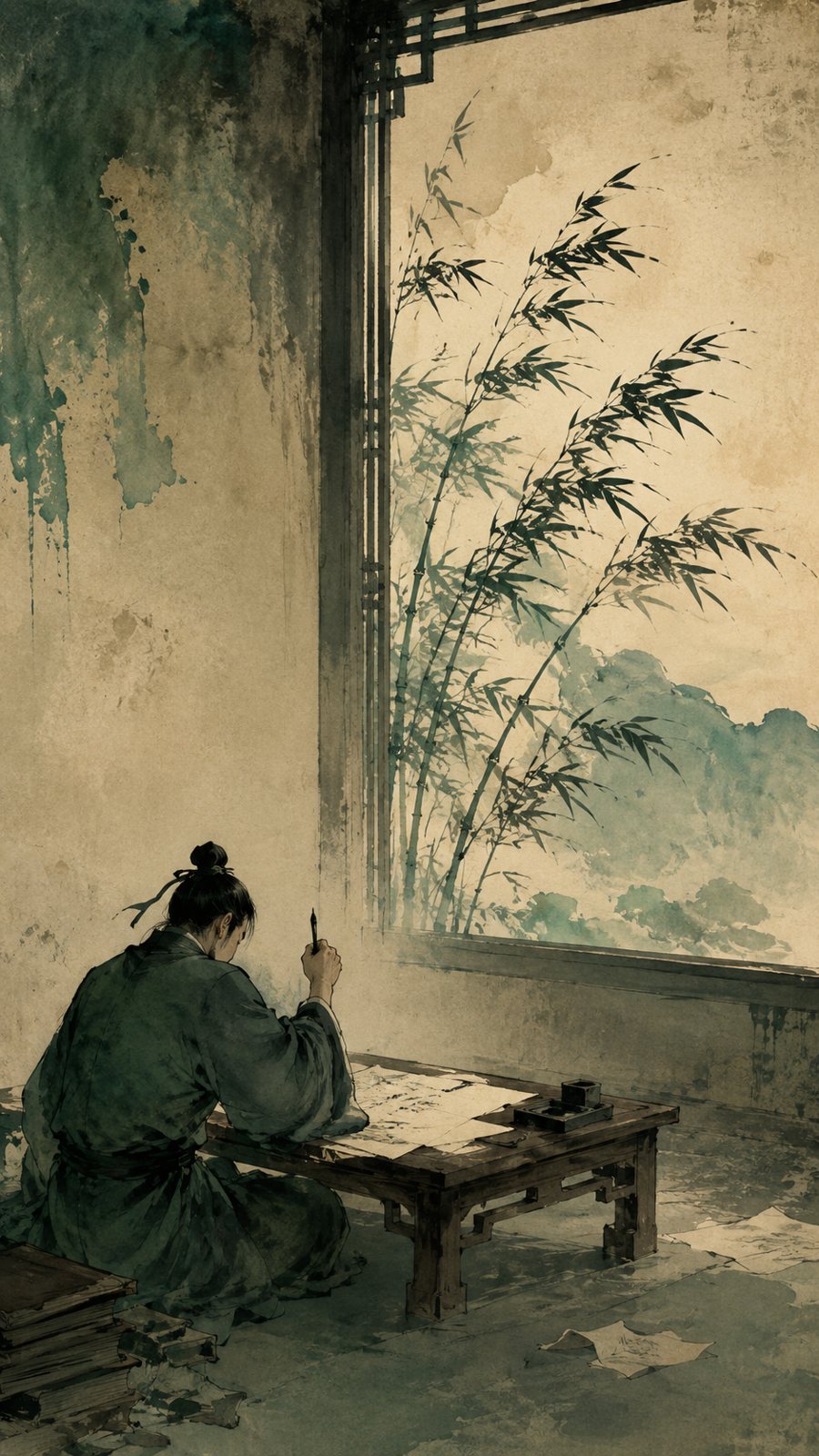
Sometime in the eighth century, a crowd gathered at a party in China to honour a painter named Zhang Zao.
We know what happened that night because a poet named Fu Zai was there and wrote it down. At some point in the evening the guests persuaded Zhang Zao to paint. He didn’t set up an easel or study a subject. He sat down in the middle of the room, legs spread wide on the floor, and took a long breath.
Then the brush began to fly. Ink seemed to spit from it. Zhang Zao was famous for painting with two brushes at once, one in each hand, and his hands cracked together as shapes appeared on the silk, not drawn so much as arrived at. When he stopped, there were pine trees, scaly and split, steep crags, and clear water running beneath turbulent clouds.
He threw the brush down, stood up, and looked at what he had made as if he were seeing it for the first time.
It was, Fu Zai wrote, as if a storm had broken and cleared, and in the clearing the true nature of ten thousand things had been briefly visible.
None of Zhang Zao’s paintings survive. We have only this account of watching one being made. It’s enough.
The idea: wu wei
The Daoists have a name for what happened in that room: wu wei. It’s usually translated as “non-doing” or “effortless action,” which makes it sound passive. It isn’t.
Zhang Zao didn’t build his pine trees detail by careful detail. The painting theory of his time held that an artist shouldn’t copy the surface of the world, but feel the spirit of the mountains and trees within themselves and let it move out through the brush. Fu Zai’s judgment was that whatever Zhang Zao was doing had moved beyond painting. The skill was still there. The straining was gone.
You’ve probably touched this yourself. Athletes call it the zone. Musicians know the moment when the song stops being played and starts playing itself. A writer has days when the sentences arrive without being fetched. On those days, nothing gets in the way between intention and action.
Why it’s so hard to reach
What gets in the way is usually us. We grip. We check ourselves. We rehearse how it will look. The more something matters, a presentation, a difficult conversation, a first attempt at something new, the tighter we hold on, and the tighter we hold, the less freely anything moves.
There’s an image in the Daoist tradition for this: a string on an instrument. Wind it too tight and it snaps, or gives a thin, strained sound. Leave it too slack and you get only a dull buzz. The note exists at one tension only.
Zhang Zao wasn’t slack. He was a master who had spent years training his hands. But at the moment of painting he wasn’t gripping either. He sat down, breathed, and let what he had practised move.
A small practice for this week
Before the next thing that matters to you, a meeting, a phone call or a page you need to write, take thirty seconds to do what Zhang Zao did.
Sit or stand where you are. Take one long, unhurried breath. Then ask: is the string too tight?
Notice your jaw, your shoulders and your hands. Let go of whatever is being held that doesn’t need to be held. You’re not trying to relax into indifference. You’re looking for the tension that lets the right note sound.
Then begin. And if you can, let the work be finished when it’s finished, and throw the brush down.
Back to the practice
This is also why qigong begins, every session, with a few minutes of standing still before any movement starts. It isn’t a warm-up. It’s the tuning of the string. When I was learning from my grandfather, he once watched me for a moment and said only: you are trying to do it. It took me years to understand that he was describing Zhang Zao’s long breath before the brush began to move.